
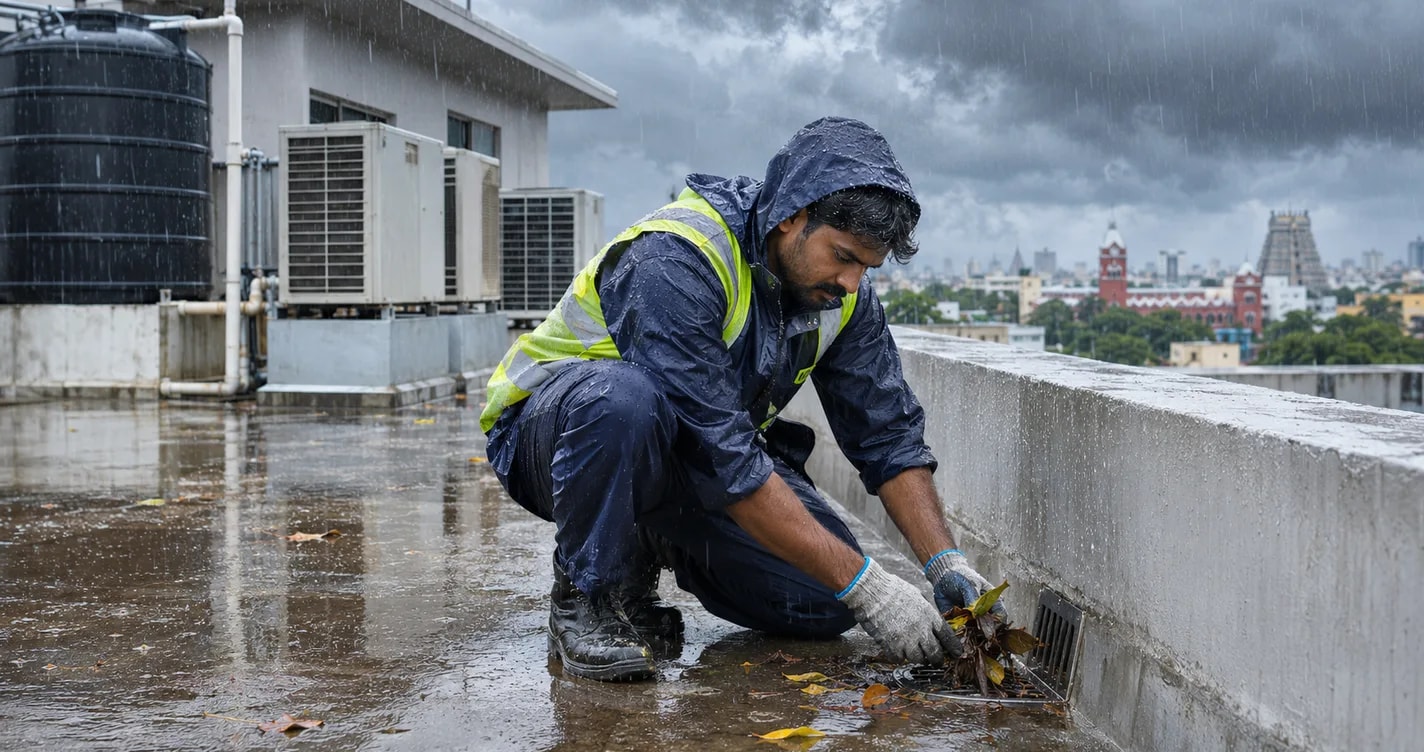
The northeast monsoon is Chennai's toughest test for any commercial building. This 2026 guide covers the practical facility management checklist — drainage, roofs, electrical safety, DG sets, lifts, housekeeping, security and emergency response — to keep your premises safe and running through heavy rain and flooding.
Every year, the northeast monsoon puts Chennai's commercial buildings through their hardest test.
Between October and December, the city receives the bulk of its annual rainfall — often in short, intense spells that overwhelm drains within hours. Cyclonic systems from the Bay of Bengal can bring days of continuous rain, strong winds and power outages. And as businesses across the city learned in 2015 and again during Cyclone Michaung in December 2023, a building that is not prepared can go from "a bit of water in the basement" to "operations shut for a week" very quickly.
The damage rarely comes from a single dramatic failure. It comes from small things that were not checked in time: a rooftop drain blocked by dry leaves, a panel room with no water barrier, a DG set with old fuel, a sump pump that nobody tested since last year, or a security team that does not know who to call when the basement starts flooding at 2 AM.
The good news is that almost all of this is preventable with structured facility management. This guide covers the practical monsoon preparedness checklist that Chennai offices, warehouses, IT parks, hospitals and residential complexes should follow in 2026 — whether you are preparing before the season or reinforcing your building mid-monsoon.
Why Monsoon Preparedness Is a Facility Management Responsibility
Monsoon readiness is often treated as a "civil works" problem that only matters when something leaks. In reality, it touches almost every part of facility management:
- Technical services — electrical panels, DG sets, pumps, lifts and HVAC all face water, humidity and power fluctuation risks.
- Housekeeping — wet floors, mud, mould, pest activity and drainage cleaning increase sharply during the rains.
- Security — guards are often the first to notice flooding, power failures and fallen trees, and they control access during emergencies.
- Compliance and safety — slip-and-fall incidents, electrical shocks and fire risk from water ingress create both safety and liability exposure.
That is why the best-prepared buildings in Chennai handle the monsoon as a planned FM programme — with a checklist, assigned owners, and clear escalation — rather than reacting after the first heavy spell. For a deeper look at the technical side of building upkeep, read our technical facility management guide.
1. Roof, Terrace and Waterproofing
The roof is where most monsoon problems start. Water that cannot drain off the terrace finds its way into ceilings, walls, lift shafts and electrical risers.
Checklist:
- Clear all rainwater outlets, gutters and downpipes of leaves, plastic and debris — and recheck after every heavy spell.
- Fit or replace mesh guards on drain outlets so debris does not enter the downpipes.
- Inspect the waterproofing membrane or coating for cracks, blisters and open joints, especially around parapets, expansion joints and equipment mounts.
- Check the sealing around rooftop equipment — chillers, cooling towers, solar panel mounts, antenna bases and water tanks.
- Secure or remove loose items on the terrace (signage, furniture, sheets, scrap) that can become dangerous in cyclonic winds.
- Inspect overhead water tank lids and terrace doors to make sure they close tightly.
A blocked roof drain during a heavy downpour can create standing water on the terrace within minutes. This is the single cheapest and most important check on the list.
2. Drainage, Basements and Stormwater
Basements, cellar parking, lift pits and ground-floor service rooms are the most vulnerable spaces in Chennai buildings during flooding.
Checklist:
- Desilt all stormwater drains, catch pits and chambers within the premises before and during the season.
- Check that the building's stormwater connection to the external drain is not blocked or reverse-flowing.
- Test every sump and dewatering pump under load — not just switch them on. Confirm float switches and auto-start work.
- Keep at least one portable submersible pump and adequate hoses on standby, with a power source that works during a mains failure.
- Stock sandbags or flood barriers for basement ramps, ground-floor entrances and service room doors.
- Mark a clear process for moving vehicles out of the basement when a heavy rain or flood alert is issued.
- Inspect lift pits for seepage and make sure lift pit drainage or pumps are working.
If your building has flooded in previous years, record the water level it reached and plan barriers and equipment relocation based on that level — not on hope.
3. Electrical Safety and Panels
Water and electricity are the most dangerous combination in any building. Monsoon is also when earthing and insulation problems surface.
Checklist:
- Inspect main LT panels, distribution boards and meter rooms for water ingress points — doors, cable entries, ceilings and walls.
- Seal cable trenches and entries; raise critical panels or install water barriers where the room is at flood risk.
- Test earthing resistance and RCCB/ELCB operation, especially for outdoor lighting, gate motors and external sockets.
- Check that external light fittings, junction boxes and signage connections are weatherproof.
- Make sure the lightning arrester system is intact and earthed.
- Define clearly who is authorised to isolate power to a flooded area, and make sure the security team knows how to reach them at any hour.
A simple rule should be communicated to every staff member: if water is near an electrical panel or socket, do not touch it — isolate first, then act.
4. DG Sets, UPS and Power Continuity
Grid power interruptions are common during heavy rain and cyclones. Your backup power is only as good as its last real test.
Checklist:
- Run the DG set on load, not just at idle, and confirm automatic changeover (AMF) works.
- Top up diesel and maintain a reserve stock — fuel deliveries may not be possible for one or two days during severe weather.
- Drain water from the fuel tank and check filters; old fuel and water contamination are common causes of DG failure.
- Protect the DG room and exhaust from water entry; check the canopy and the drainage around the DG platform.
- Service UPS batteries and confirm backup duration for critical loads such as servers, CCTV, access control and emergency lighting.
- Confirm that sump pumps and fire pumps are on the DG-backed supply.
If your DG set is in the basement or at ground level in a flood-prone area, plan for what happens if it cannot run — including which loads must be shut down safely.
5. Lifts, HVAC and Building Systems
Checklist:
- Ask your lift maintenance vendor for a pre-monsoon inspection, including the lift pit, machine room and emergency rescue device.
- Agree a protocol to park lifts on an upper floor and switch them off if the basement or lift pit is at risk of flooding.
- Check HVAC condensate drains and AHU trays — blocked condensate lines cause ceiling leaks that are often mistaken for roof leaks.
- Inspect cooling towers and outdoor units for secure mounting against strong winds.
- Monitor humidity in server rooms, records rooms and storage areas; use dehumidifiers where needed.
- Test fire alarm panels, smoke detectors and sprinkler systems — humidity can cause false alarms and faults.
6. Housekeeping During the Monsoon
The monsoon doubles the housekeeping workload. A well-planned housekeeping schedule prevents accidents, hygiene issues and long-term damage.
Checklist:
- Place anti-slip mats and "wet floor" signage at every entrance, lobby, lift landing and staircase.
- Increase the frequency of mopping and drying at entry points during rain hours.
- Provide umbrella stands or umbrella bags at entrances to keep water off lobby floors.
- Clean and disinfect washrooms more frequently; check floor traps and drains for backflow.
- Watch for damp patches and mould on walls, ceilings, carpets and furniture — treat early before it spreads.
- Step up pest control, especially for mosquitoes, cockroaches and rodents, and remove any stagnant water in pots, trays, scrap and terrace corners.
- Keep extra stock of housekeeping consumables, as supply runs may be disrupted.
Stagnant water is also a public health concern in Chennai during the rains. Regular checks for mosquito breeding sites protect both employees and visitors.
7. Security and Access Control
Security teams are on duty 24/7 and are usually the first to see a problem. They need to be trained and equipped for the monsoon, not just for access control.
Checklist:
- Brief guards on monsoon-specific duties: watching water levels in the basement and around the building, reporting leaks, and checking for fallen trees or cables.
- Provide raincoats, gumboots, torches and charged emergency lights for every post.
- Keep an updated emergency contact list at the security desk — facility manager, electrician, plumber, lift vendor, DG vendor, and local emergency services.
- Check that CCTV cameras, especially outdoor ones, are weatherproof and recording properly.
- Test boom barriers, gate motors and access control readers exposed to rain.
- Define how visitors, deliveries and vehicle movement will be handled during red-alert days.
8. Emergency Response and Business Continuity
When the India Meteorological Department or the Greater Chennai Corporation issues a heavy rain or cyclone warning, there is usually only a short window to act. A written plan makes that window count.
Your monsoon emergency plan should cover:
- Roles — who decides on closure or work-from-home, who coordinates on site, and who communicates with employees and tenants.
- Triggers — what alert level or water level leads to which action (move vehicles, isolate power, shut lifts, send staff home).
- Critical assets — which equipment, records and inventory must be moved to higher floors or protected first.
- Essential staff — which technicians, housekeeping and security staff will remain on site, and how they will be fed, accommodated and kept safe.
- Communication — a simple channel (WhatsApp group, SMS or app) to share updates with all stakeholders.
- Recovery — the sequence for inspection, cleaning, drying, electrical testing and safe restart after the water recedes.
Run at least one tabletop walkthrough of this plan with your FM team, so that everyone knows their role before the night it is actually needed.
After the Rain — The Post-Monsoon Inspection
Many monsoon problems only become visible after the season ends. Once the heavy rains are over, schedule a structured inspection:
- Map every leak, seepage and damp patch recorded during the season and plan permanent repairs.
- Inspect electrical panels, cable trenches and DG rooms that were exposed to water.
- Check for structural cracks, plaster damage and corrosion on exposed steel.
- Review pest activity and deep-clean areas affected by water.
- Document what went wrong and what worked — and update next year's checklist.
This is also a good point to run a full building review. Our facility management audit checklist can help you structure it.
Put Monsoon Readiness Into Your FM Contract
If you outsource facility management, monsoon preparedness should not depend on goodwill. Build it into your contract and SLA:
| What to include | Why it matters | | --- | --- | | Pre-monsoon inspection and report | Ensures checks happen before the season, not after the first flood | | Drain and roof cleaning frequency | Sets clear expectations during the rainy months | | Pump, DG and panel testing schedule | Confirms backup systems are proven, not assumed | | Emergency response times | Defines how fast technicians must respond during severe weather | | Standby manpower during red alerts | Guarantees essential staff will be available on site | | Post-monsoon inspection | Captures damage and repair needs for planning |
For guidance on writing these terms, read our guide on how to write a facility management SLA.
How Easy Facility Services Helps Chennai Buildings Prepare for the Monsoon
At Easy Facility Services, monsoon preparedness is part of how we manage facilities across Chennai — not an add-on. Our integrated approach brings technical services, housekeeping and security together under one plan, so nothing falls between vendors when the rain arrives.
- Pre-monsoon technical checks covering roofs, drains, pumps, electrical panels, DG sets and lifts.
- Monsoon housekeeping schedules with increased entry-point cleaning, anti-slip measures, washroom hygiene and pest control.
- Trained security teams who know how to monitor water levels, respond to power failures and escalate quickly.
- Digital reporting through the EFS ERP, so issues raised on site are logged, assigned and tracked to closure — with visibility for facility managers and clients.
- Emergency response support during heavy rain and cyclone alerts, and structured recovery once the water recedes.
The monsoon will come every year. Whether it disrupts your business depends on how well your building is prepared.
Book a Free Monsoon Readiness Assessment | Call us: +91 73059 12983
Ravikumar is the CTCO of Easy Facility Services Private Limited, one of Chennai's leading integrated facility management companies. Easy Facility Services provides professional housekeeping services, security services, MEP services, pest control services, building maintenance, payroll services, and integrated facility management for commercial, industrial, and corporate facilities across Chennai and Tamil Nadu since 2015.
Ravikumar
CTCO, Easy Facility Services Private Limited
With over 10 years of experience in facility management across Chennai and Tamil Nadu, leading Easy Facility Services Private Limited to serve 500+ businesses.