
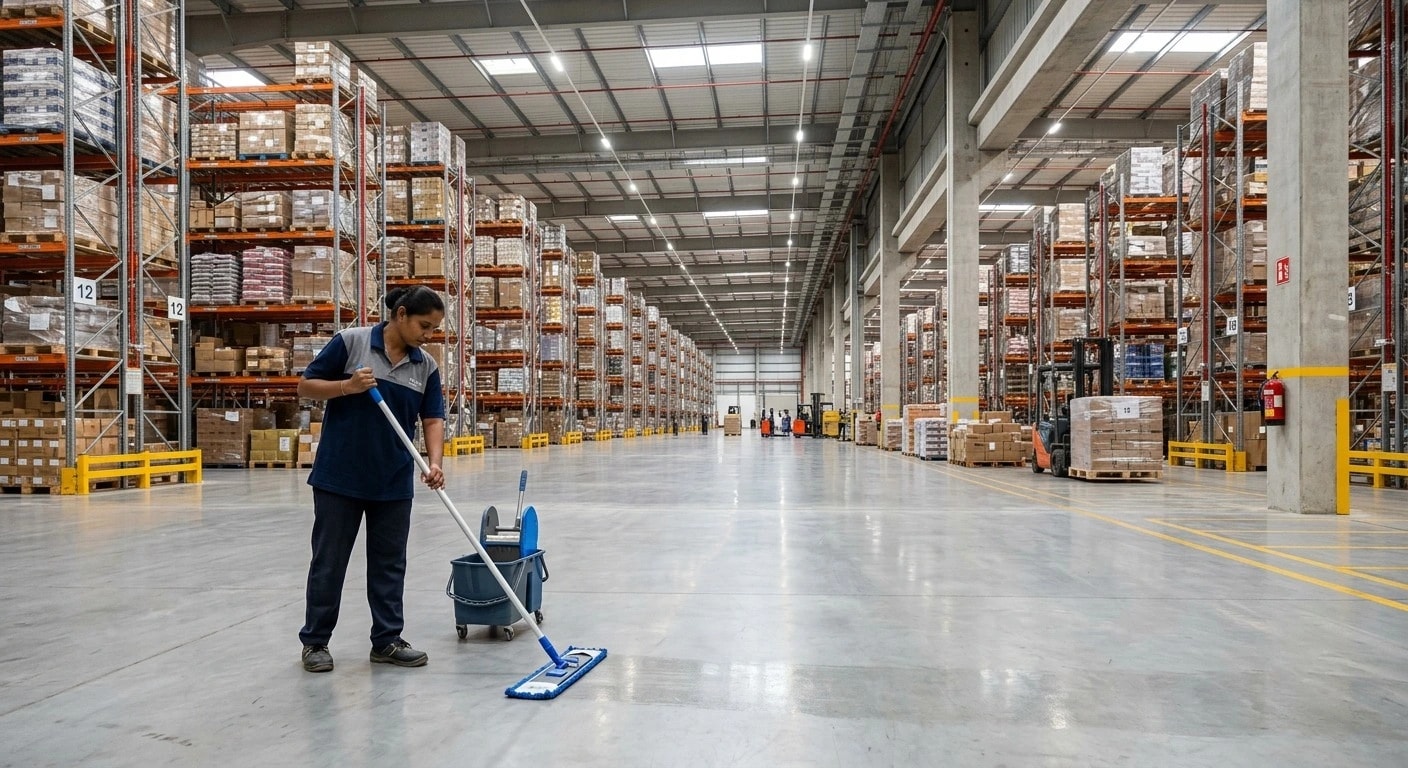
Warehouse facility management in Chennai demands more than basic cleaning — it requires floor maintenance, pest control, fire safety, labour compliance and integrated FM services built for high-throughput operations. This complete 2026 guide covers everything.
A warehouse is not a passive storage space — it is a live operational environment that moves goods, people, and machinery through its floor every single day.
The condition of that environment has a direct bearing on operational efficiency, worker safety, stock integrity, and regulatory compliance. A poorly managed warehouse floor creates accident risk for workers and machinery operators. Inadequate pest control threatens stock integrity and customer relationships. Poor housekeeping slows operations and creates the conditions for slip, trip, and fall incidents. Lapsed fire safety maintenance turns a storage facility into a liability.
Chennai is one of South India's most important logistics and warehousing hubs. The city's port connectivity, road infrastructure, and industrial corridors — from Ambattur and Padi to Sriperumbudur, Oragadam, and the GST Road logistics belt — support a large and growing warehouse ecosystem serving manufacturing, e-commerce, FMCG, retail, and third-party logistics operators.
The organisations that operate warehouses in Chennai's logistics corridors need facility management that understands the operational demands of a working warehouse — not residential-grade housekeeping applied to an industrial setting.
This is the complete guide to professional facility management for warehouses in Chennai in 2026.
What Makes Warehouse FM Different From Office or Retail FM
Warehouse facility management is a distinct discipline. The scale, the operational environment, the safety requirements, and the regulatory framework are all different from what applies to an office building or a retail outlet.
Scale and floor area: A typical Chennai warehouse covers anywhere from 10,000 to 200,000 square feet of floor area. Housekeeping and maintenance at this scale requires industrial-grade equipment, organised staffing, and a systematic approach — not the small team and basic tools appropriate for an office.
Operational interference: Warehouses operate continuously — often in shifts. Facility management must be planned and executed around active operations: forklifts moving, pick-and-pack teams working, loading docks in use. Facility teams that cannot integrate with live warehouse operations create safety conflicts and operational friction.
Industrial floor surfaces: Warehouse floors — typically concrete, often treated or epoxy-coated — require specific cleaning methods and equipment. Industrial sweepers and scrubbers, not mops and buckets. Incorrect cleaning of treated concrete floors damages the surface and increases maintenance costs.
Heavy pest pressure: Warehouses storing food, FMCG, paper, or organic materials face persistent, serious pest pressure. Cockroaches, rodents, and insects are attracted by the combination of food materials, warmth, and structural voids that characterise most warehouse buildings. Pest infestations in a warehouse can result in stock write-offs, customer complaints, failed audits, and regulatory action.
Safety and compliance complexity: Warehouse safety compliance involves fire safety systems, electrical installation certification, floor marking and signage, dock leveller maintenance, emergency exit maintenance, and increasingly, regulatory inspections by factory and labour authorities. Facility management must understand and support this compliance framework, not operate independently of it.
High labour deployment: Warehouses deploy large numbers of contract workers — housekeeping, security, and maintenance staff. The statutory compliance obligations for these workers — PF, ESI, wages, working conditions — are significant and carry real principal employer liability for the warehouse operator.
Housekeeping Services for Chennai Warehouses
Warehouse housekeeping is not office cleaning at scale — it is a different service that requires different equipment, different staffing levels, and a different operational approach.
Floor Cleaning and Maintenance
The warehouse floor is the single most critical housekeeping surface in any warehousing operation. Dust, debris, and spillages on a warehouse floor create slip and trip hazards for workers and create contamination risk for goods. In Chennai's environment, dust ingress is particularly significant — warehouses near industrial estates and highways accumulate dust rapidly.
Professional warehouse floor cleaning uses industrial ride-on sweepers and scrubbers appropriate to the floor area and surface type. Daily sweeping removes loose dust and debris. Periodic wet scrubbing removes embedded dirt and maintains surface cleanliness. For epoxy-coated floors, correct cleaning chemistry is essential to avoid damaging the coating.
Floor marking — aisle markings, safety zones, no-go areas — must be maintained clearly. Damaged or faded floor markings are a safety issue and a compliance failure.
Loading Docks and Receiving Areas
Loading docks and receiving areas are the highest-traffic, highest-contamination zones in any warehouse. Vehicles, packaging materials, loose goods, and foot traffic create concentrated housekeeping demands at dock areas. Daily cleaning of dock areas — including dock levellers, dock seals, and surrounding floor areas — is essential to maintain both operational cleanliness and pest exclusion.
Racking and Storage Areas
Warehouse racking accumulates dust and, in food and FMCG warehouses, organic debris that attracts pests. Regular racking cleaning — appropriate to the type and density of storage — prevents the accumulation that creates pest habitat and reduces the effectiveness of pest control treatments.
Common Areas and Welfare Facilities
Worker welfare facilities — restrooms, canteens, rest areas — must meet the standards required under the applicable labour regulations. Clean, well-maintained welfare facilities are a regulatory requirement, a worker wellbeing requirement, and a factor in workforce retention. Warehouse welfare facility standards are inspected by factory and labour authorities.
Waste Management
Warehouses generate significant waste — packaging materials, damaged goods, plastic wrapping, cardboard, and food waste from canteens. Professional waste management services implement correct waste segregation, maintain clean waste collection points, coordinate waste collection, and ensure compliance with applicable waste regulations. Accumulated waste in a warehouse creates fire risk, pest habitat, and operational clutter.
Security Services for Chennai Warehouses
Warehouse security is a serious operational requirement. The value of goods stored in a warehouse makes it a target for both external theft and internal pilferage. Professional warehouse security goes well beyond gate guarding.
Gate and Access Control
Warehouse gate security manages the continuous flow of inbound and outbound vehicles — trucks, tempos, and delivery vehicles — alongside employee and contractor access. Professional gate security records every vehicle movement, verifies driver credentials, logs cargo details against despatch documentation, and ensures that no vehicle enters or leaves without authorisation and documentation.
Poorly managed gate security is the primary cause of cargo discrepancies and stock losses in Chennai warehouse operations.
Internal Security and Surveillance
Internal warehouse security covers floor patrol, monitoring of high-value storage zones, supervision of loading and unloading operations, and coordination with CCTV systems. Professional internal security teams are trained to identify pilferage risk, document irregularities, and escalate issues appropriately.
Night and After-Hours Security
After operating hours, warehouse security must maintain perimeter security, control access for authorised personnel (cleaning teams, maintenance contractors), and respond to alarm events. Professional night security for a Chennai warehouse typically includes regular perimeter patrol, attendance logging, and direct communication with management for any security incidents.
Labour Gate Management
Large warehouses with significant daily worker attendance require formal labour gate management — biometric or card-based attendance systems, contractor worker verification, and coordination between security and HR/operations teams. This function is distinct from cargo gate management and requires dedicated staffing.
MEP Maintenance for Chennai Warehouses
Warehouse MEP systems are the backbone of operational continuity. Unlike an office environment where system failures are inconvenient, warehouse MEP failures can halt operations, damage goods, and create safety risks.
Electrical Systems
Warehouse electrical systems power lighting, material handling equipment charging, dock levellers, security and CCTV systems, and office areas. Regular electrical maintenance — distribution board inspection, cable and connection checks, ELCB and MCB testing, emergency lighting verification — prevents the failures that cause operational stoppages and create safety risks.
For warehouses with high material handling equipment usage, earthing system maintenance and UPS reliability are particularly important.
Lighting Maintenance
Warehouse lighting — typically LED high-bay fixtures at 8–12 metre height — is critical for both operational efficiency and safety. Insufficient lighting in a working warehouse creates accident risk. Regular lighting maintenance, prompt replacement of failed fixtures, and lux-level monitoring ensure that lighting meets both operational and regulatory standards.
Plumbing and Drainage
Warehouse plumbing must maintain reliable water supply and drainage for welfare facilities, fire suppression systems, and wash-down points. Drainage maintenance is particularly important — blocked drains in a warehouse create pooling that damages stock, creates pest habitat, and creates slip hazards.
Fire Safety Systems
Fire safety system maintenance is one of the most important MEP responsibilities in any warehouse. Smoke and heat detectors, sprinkler systems, fire hydrant points, fire extinguisher inspection and certification, and emergency exit lighting must all be maintained to regulatory standard and inspected at the required intervals.
For Chennai warehouses storing flammable or hazardous materials, fire safety maintenance is a regulatory requirement with serious consequences for lapse.
Pest Control for Chennai Warehouses
Warehouse pest control is perhaps the single most commercially critical facility management service in a warehouse environment. The consequences of pest infestation in a warehouse go well beyond aesthetic concerns — they include stock write-offs, customer claims, failed third-party audits, loss of certifications, and reputational damage.
Chennai's warm climate, combined with the food materials, paper, and organic content stored in most warehouses, creates significant and persistent pest pressure.
Rodent Control
Rodents — particularly rats and mice — are the most serious pest threat in most Chennai warehouses. They damage packaging, contaminate stock, gnaw electrical cables (creating fire risk), and breed rapidly in structural voids and pallet stacks. Professional warehouse rodent control uses a combination of perimeter bait stations, internal trapping, structural exclusion, and regular monitoring to maintain rodent-free conditions.
Cockroach Control
Cockroach infestations in food, pharmaceutical, or FMCG warehouses are an audit failure waiting to happen. Professional pest control services for warehouse cockroach control use gel baiting, residual sprays, and structural treatment to eliminate established populations and prevent re-infestation.
Flying Insect Control
Flying insects — flies, moths, and beetles — are particularly problematic in food warehouses. Professional flying insect control combines UV light trap maintenance, chemical treatment where required, and structural recommendations to reduce entry points.
Scheduled Treatment Programme
Effective warehouse pest control is a programme, not a reactive call-out service. Professional pest control for Chennai warehouses runs monthly scheduled treatments with full documentation — treatment records, pest activity logs, and corrective action tracking — that support third-party audits and customer inspections.
Compliance for Chennai Warehouses
Warehouse facility management carries substantial statutory compliance obligations. These fall into two broad categories.
Labour and Statutory Compliance
Every housekeeping, security, and maintenance worker deployed at a Chennai warehouse is a contract worker. As the principal employer, the warehouse operator carries joint liability for their statutory entitlements — PF, ESI, minimum wages, working hours, and welfare facilities.
Monthly PF ECR, ESI challans, and wage compliance documentation from the FM provider are essential for managing this liability. Warehouse operators who cannot produce these records during a labour inspection face direct liability for arrears and penalties.
Building and Safety Compliance
Warehouse building compliance covers factory registration (where applicable), fire NOC, electrical installation certification, lift and dock leveller certification, and environmental consents. Facility management teams must understand which compliance obligations are in scope and ensure that maintenance activities — electrical inspection, fire system servicing, structural maintenance — are documented and conducted at the required intervals.
For the complete compliance framework applicable to Chennai facility management operations, read our facility management compliance guide.
How to Choose the Right FM Partner for Your Chennai Warehouse
Warehouse-specific experience: The most important criterion. Has the company actually managed warehouses of comparable size and type in Chennai? Ask for references from current warehouse clients — not just office or commercial building experience applied to a warehouse context.
Industrial equipment capability: Do they own and operate industrial floor sweepers and scrubbers of the right type for your floor area and surface? FM providers without industrial cleaning equipment cannot deliver warehouse-standard housekeeping.
Pest control integration: Is pest control part of their integrated service offering? A single FM provider managing both housekeeping and pest control delivers better outcomes — the two services are operationally interdependent in a warehouse environment.
Safety awareness: Are their staff trained in warehouse safety — forklift awareness, restricted zone protocols, PPE requirements, and emergency procedures? Staff who are not trained for a warehouse environment create safety liability.
Compliance documentation: Can they produce, monthly, the full suite of statutory compliance documentation for all deployed staff? This is non-negotiable for any warehouse operator with regulatory exposure.
SLA quality: A strong SLA with specific benchmarks for attendance, floor cleaning frequency, pest treatment scheduling, response times, and penalty clauses is essential. Read our FM SLA guide for the complete framework.
How Easy Facility Services Manages Warehouse FM in Chennai
At Easy Facility Services Private Limited, we provide professional integrated facility management for warehouses across Chennai's logistics corridors — Ambattur, Padi, Sriperumbudur, Oragadam, GST Road, Maraimalai Nagar, and the Ennore-Manali industrial belt.
Our warehouse FM offering covers the complete operational requirement — housekeeping services with industrial floor cleaning equipment, security services with gate and cargo management protocols, pest control services on scheduled treatment programmes, waste management, MEP services, electrical services, plumbing services, building maintenance, and manpower services — all under one contract, one point of contact, and complete accountability.
All deployed staff are background verified, uniformed, trained for warehouse environments, and covered for full statutory compliance. We provide monthly PF ECR, ESI challans, and wage compliance documentation to every client — protecting your principal employer position in every inspection.
If you operate a warehouse in Chennai and would like to discuss how professional integrated facility management can raise your operational standards, protect your compliance position, and reduce the risk of pest, safety, or regulatory incidents, our team is ready to conduct a free warehouse FM assessment.
Get a Free Warehouse FM Assessment | Call us: +91 73059 12983
Ravikumar is the CTCO of Easy Facility Services Private Limited, one of Chennai's leading warehouse facility management companies. Easy Facility Services provides professional housekeeping services, security services, pest control services, waste management, MEP services, building maintenance, manpower services, and integrated facility management for warehouses and industrial facilities across Chennai and Tamil Nadu since 2015.
Ravikumar
CTCO, Easy Facility Services Private Limited
With over 10 years of experience in facility management across Chennai and Tamil Nadu, leading Easy Facility Services Private Limited to serve 500+ businesses.