
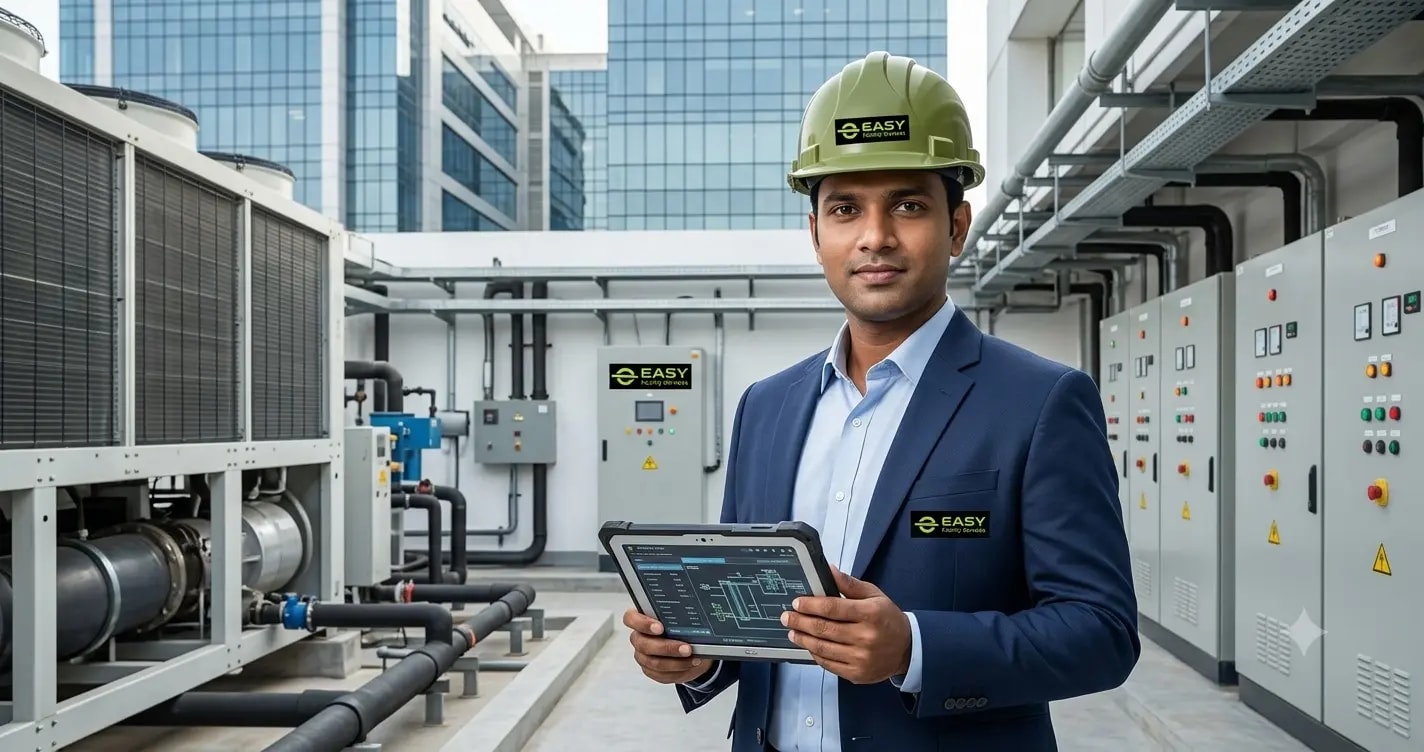
Technical facility management covers MEP, electrical, plumbing, HVAC, lifts and building systems. This complete 2026 guide covers everything Chennai commercial building managers need to know about professional technical FM.
Every commercial building in Chennai depends on systems that most people never see.
The HVAC plant that maintains comfortable temperatures in the boardroom. The electrical distribution boards that power every workstation, server, and light fitting in the building. The water pumps that maintain supply pressure to every floor. The lifts that carry thousands of people up and down every day. The fire suppression system that stands silent and ready but must work without fail when called upon.
These systems are the technical infrastructure of the building — and when they work reliably, nobody notices them. When they fail, everything stops.
Technical facility management is the professional discipline of keeping these systems running — reliably, efficiently, safely, and in compliance with the regulatory requirements that govern building operations in Chennai. It is the most complex, the most consequential, and the most frequently underinvested aspect of facility management for Chennai's commercial buildings.
In 2026, professional technical facility management from specialist providers is transforming how Chennai's commercial properties manage their building systems — moving from reactive repair to planned preventive maintenance, from paper-based service records to digital maintenance management, and from fragmented multi-vendor arrangements to integrated technical FM under single accountable management.
This is the complete guide.
What Is Technical Facility Management — And Why Is It Different?
Technical facility management — also called hard services FM or building services management — covers the maintenance and operation of a building's mechanical, electrical, and plumbing (MEP) systems, along with all associated technical building infrastructure.
It is distinct from soft services FM (housekeeping, security, manpower) in three critical ways:
Technical complexity: Technical FM requires qualified, licensed technicians — electricians, plumbers, HVAC engineers, lift technicians — with specific trade qualifications and practical expertise. The work cannot be done by general workers. Errors have direct consequences for building safety and operational continuity.
Regulatory compliance: Technical building systems in Chennai are subject to statutory inspection and certification requirements — electrical inspections, lift certification, fire safety certification, STP compliance. Technical FM must manage these compliance obligations as an integral part of the service.
Failure consequences: When a housekeeping standard slips, the floor is dirty. When a technical system fails, the building may become uninhabitable, unsafe, or unable to operate. The consequences of technical FM failures are immediate, significant, and in some cases, dangerous.
The Complete Scope of Technical Facility Management
HVAC Management
Heating, Ventilation, and Air Conditioning management is the highest-priority technical FM function for Chennai commercial buildings — because Chennai's climate makes air conditioning not just a comfort provision but an operational necessity for 10 or more months of the year.
What technical HVAC management covers:
- Monthly inspection and filter cleaning for all split, cassette, and window AC units
- Monthly inspection of all AHUs (Air Handling Units) — coils, filters, fans, and controls
- Quarterly refrigerant level checks and leak testing
- Quarterly condenser coil cleaning — critical in Chennai's dusty environment
- VRF system monthly inspection — outdoor units, indoor units, refrigerant circuits, and controls
- Chiller inspection and maintenance — chilled water systems in large commercial buildings
- Cooling tower maintenance — cleaning, water treatment, and mechanical inspection
- Annual comprehensive HVAC audit — system performance, energy efficiency, and capacity assessment
- Emergency fault response — rapid diagnosis and repair for AC failures
In Chennai, HVAC management requires specific attention to:
- Humidity management — coastal Chennai's high humidity accelerates corrosion in HVAC components
- Filter management — Chennai's urban dust load requires more frequent filter replacement than in cleaner environments
- Pre-summer preparation — comprehensive HVAC service before April/May to prevent peak summer failures
- Post-monsoon inspection — checking for water ingress into outdoor units and AHU rooms during monsoon season
Electrical Systems Management
Electrical systems management covers the complete electrical infrastructure of the building — from the incoming supply through the distribution system to every point of use.
What technical electrical management covers:
- Monthly inspection of all main distribution boards (MDBs) and sub-distribution boards (SDBs)
- Monthly testing of all ELCBs (Earth Leakage Circuit Breakers) and RCDs (Residual Current Devices)
- Monthly testing of emergency lighting systems — battery backup duration verification
- Monthly fire alarm panel inspection — no fault indicators, all zones operational
- Monthly DG set operation check — fuel levels, battery, coolant, oil
- Monthly DG set load test — minimum 30 minutes under load
- Quarterly thermal imaging scan of all distribution boards — identifying hot spots before they cause failures
- Quarterly insulation resistance testing of main feeder cables
- Quarterly UPS battery capacity testing
- Annual comprehensive electrical audit by a licensed electrical contractor
- Annual earth resistance testing — all earthing systems
- Annual transformer inspection — oil levels, cooling, and connection integrity
- TANGEDCO compliance management — power factor, metering, and demand charges
- Emergency electrical fault response — 24/7 availability for critical system failures
Chennai-specific electrical challenges:
- Humidity-driven corrosion in electrical connections and terminal blocks — requires regular inspection and treatment
- Power quality issues — voltage fluctuations affecting sensitive equipment, requiring UPS and voltage stabiliser management
- Monsoon season risks — water ingress into outdoor electrical installations and flooded basement electrical rooms
Plumbing and Water Systems Management
Water system management covers the complete plumbing infrastructure — supply, storage, distribution, drainage, and treatment systems.
What technical plumbing management covers:
- Monthly visual inspection of all accessible pipework — checking for leaks, corrosion, and damage
- Monthly water pump operation check — pressure, flow, and current draw
- Monthly overhead tank and sump inspection — water levels, float valve operation, structural condition
- Monthly STP operation monitoring and effluent parameter recording
- Quarterly overhead tank cleaning and disinfection — essential in Chennai's climate for water quality
- Quarterly underground sump cleaning
- Quarterly high-pressure drainage jetting — clearing accumulated grease, scale, and debris
- Quarterly fire hydrant system pressure testing
- Water pump annual full service — impeller inspection, seal replacement, motor check
- Annual plumbing system audit — pipework condition, water quality assessment, compliance review
- Annual STP comprehensive service — biological treatment systems, aeration, and settling
- TNPCB STP compliance documentation management
- Emergency plumbing fault response — burst pipes, pump failures, drainage blockages
Chennai-specific plumbing challenges:
- Water scarcity management — tanker water quality management during CMWSSB supply deficits
- Hard water scale management — Chennai's groundwater creates scale in pipes, water heaters, and fittings
- Monsoon drainage management — pre-monsoon jetting and post-monsoon drainage inspection
- Coastal corrosion — accelerated corrosion in metallic fittings in coastal proximity areas
Lift and Vertical Transport Management
Lift management is a regulated technical FM function — with statutory inspection requirements under the Tamil Nadu Lifts Rules.
What lift management covers:
- Monthly scheduled maintenance by a licensed lift maintenance contractor
- Monthly safety system testing — overspeed governor, buffers, and limit switches
- Monthly emergency phone testing — all lift cabins
- Annual comprehensive lift inspection and certification by the Tamil Nadu Lift Inspector
- Emergency lift fault response — rapid response to lift breakdowns and passenger entrapment
- Escalator maintenance (where applicable) — step inspection, handrail servicing, lubrication
Fire Safety Systems Management
Fire safety system management is a statutory requirement and a life safety obligation — the systems must work when needed, every time.
What fire safety management covers:
- Monthly fire alarm panel inspection — all zones operational, no faults
- Monthly fire extinguisher inspection — pressure check, seal inspection, location verification
- Monthly emergency lighting test — all exit signs and emergency lights functional
- Quarterly fire hydrant pressure test
- Quarterly sprinkler system inspection (where applicable)
- Annual comprehensive fire safety audit
- Annual fire extinguisher service and recharging
- Annual fire hydrant flow test and certification
- Annual fire suppression system inspection and certification
- Fire NOC compliance management — Tamil Nadu Fire and Rescue Services
- Emergency fire system fault response
Building Automation and Smart Systems
Modern Chennai commercial buildings increasingly incorporate building automation systems (BAS) and smart building technology — requiring technical FM expertise that goes beyond traditional trade skills.
What smart building technical management covers:
- BAS monitoring and programming — HVAC, lighting, and access control integration
- Energy management system operation — monitoring consumption, identifying inefficiencies
- CCTV and access control system technical maintenance
- IT-OT integration support — connecting building systems to management platforms
- IoT sensor monitoring and maintenance — occupancy, air quality, energy, and equipment performance
Why Planned Preventive Maintenance Is the Only Rational Approach
The fundamental choice in technical facility management is between planned preventive maintenance and reactive maintenance. After more than a decade of managing technical FM across hundreds of Chennai commercial properties, we can state without qualification: reactive maintenance is more expensive, less reliable, and more disruptive than planned preventive maintenance — in every case.
The reactive maintenance cycle: A building managed reactively replaces components when they fail, calls technicians when systems stop working, and discovers compliance certification gaps when inspectors arrive. The consequences are predictable — unplanned downtime, emergency repair premiums, accelerated equipment deterioration, compliance penalties, and the constant stress of not knowing what will fail next.
The planned preventive maintenance cycle: A building managed with planned preventive maintenance inspects, services, and replaces components on schedule — before failures occur. Developing faults are identified during routine inspections, when they can be corrected at routine rates rather than emergency rates. Compliance certifications are tracked and renewed before they expire. Systems run at designed efficiency rather than the degraded performance of poorly maintained equipment.
The financial case: In Chennai's commercial sector, the annual cost of a comprehensive planned preventive maintenance programme for a medium-sized office building is typically ₹3,00,000–8,00,000. The cost of a single major unplanned system failure — a chiller breakdown during summer, an electrical fault causing a fire, a lift failure during peak hours — routinely exceeds this annual maintenance budget in direct repair costs alone, before accounting for business disruption and reputational consequences.
The planned maintenance programme is not a cost. It is an investment that delivers measurably better outcomes at lower total cost.
Technical FM Compliance — What Chennai Buildings Must Maintain
Technical FM compliance in Chennai involves multiple regulatory frameworks, each with its own inspection requirements, certification bodies, and renewal timelines.
Tamil Nadu Electrical Licensing Board: All electrical work in commercial buildings must be performed by licensed electrical contractors and workers. Annual electrical installation inspection certificates are required for commercial establishments.
TANGEDCO: Power factor compliance, metering accuracy, and maximum demand management are regulatory requirements for commercial electricity connections. Non-compliance results in penalty surcharges on electricity bills.
Tamil Nadu Electrical Inspectorate: Periodic inspection and certification of electrical installations above certain capacity thresholds.
Tamil Nadu Lift Inspector: Annual inspection and certification of all passenger and goods lifts under the Tamil Nadu Lifts Rules. Lifts operating without current certification are illegal and create significant liability for the building owner.
Tamil Nadu Fire and Rescue Services: Fire NOC for commercial buildings, annual fire safety inspection, and certification of fire suppression systems.
Tamil Nadu Pollution Control Board: STP effluent quality compliance, periodic effluent testing, and annual returns for buildings with sewage treatment plants.
Indian Boilers Act: Annual inspection and certification for boilers and pressure vessels.
Professional technical FM management tracks all of these compliance requirements, coordinates with the relevant inspection bodies, and maintains current certification — so building owners and facility managers are never caught with lapsed compliance.
How to Evaluate a Technical FM Provider in Chennai
Licensing and qualifications: Ask for proof of electrical contractor's licence, and verify that deployed electricians hold Grade A or Grade B wireman licences from the Tamil Nadu Electrical Licensing Board. For lift maintenance, verify that the contractor holds a valid lift maintenance licence.
Planned maintenance programme: Ask to see a sample annual preventive maintenance schedule. A professional technical FM provider plans their work — they do not just respond to calls.
Thermal imaging capability: Quarterly thermal imaging of electrical distribution boards is a fundamental best practice in technical FM. Ask whether the provider has in-house thermal imaging equipment.
Emergency response commitment: What is their commitment for emergency response to critical system failures — 24 hours a day, 7 days a week? Get this in writing as part of the SLA.
Compliance management: Does the company track and manage your building's certification requirements — lift certification, electrical inspection, fire NOC, STP compliance — as part of their service? This is the mark of a genuinely comprehensive technical FM provider.
Documentation: After every maintenance visit, you should receive a documented service report — what was inspected, what was found, what was corrected, and any recommendations. This documentation supports compliance and provides a maintenance history.
References: Ask for references from current commercial property clients in Chennai. The quality of technical FM is visible in the buildings they manage — ask to see one.
How Easy Facility Services Provides Technical Facility Management in Chennai
At Easy Facility Services Private Limited, our technical facility management services cover the complete MEP and building systems scope — MEP services, electrical services, plumbing services, and building maintenance services — delivered by licensed contractors and qualified technical workers under a planned preventive maintenance framework.
Every client receives a customised annual maintenance schedule — planned around their specific building systems, compliance requirements, and operational priorities. After every maintenance visit, clients receive documented service reports. We track and manage all statutory compliance requirements — lift certifications, electrical inspections, fire NOC renewal, and STP compliance — as a standard component of our service.
Our technical FM integrates seamlessly with our soft services — housekeeping, security, pest control, and waste management — under a single integrated FM contract with one point of contact and complete accountability.
We serve corporate offices, IT parks, hospitals, hotels, manufacturing facilities, retail complexes, and residential complexes across Chennai and Tamil Nadu.
If you would like to discuss technical facility management for your Chennai commercial building, our team would be happy to conduct a free technical assessment and provide a customised maintenance proposal.
Get a Free Technical FM Assessment | Call us: +91 73059 12983
Ravikumar is the CTCO of Easy Facility Services Private Limited, one of Chennai's leading technical facility management companies. Easy Facility Services provides professional MEP services, electrical services, plumbing services, building maintenance, housekeeping, security, and integrated facility management across Chennai and Tamil Nadu since 2015.
Ravikumar
CTCO, Easy Facility Services Private Limited
With over 10 years of experience in facility management across Chennai and Tamil Nadu, leading Easy Facility Services Private Limited to serve 500+ businesses.