
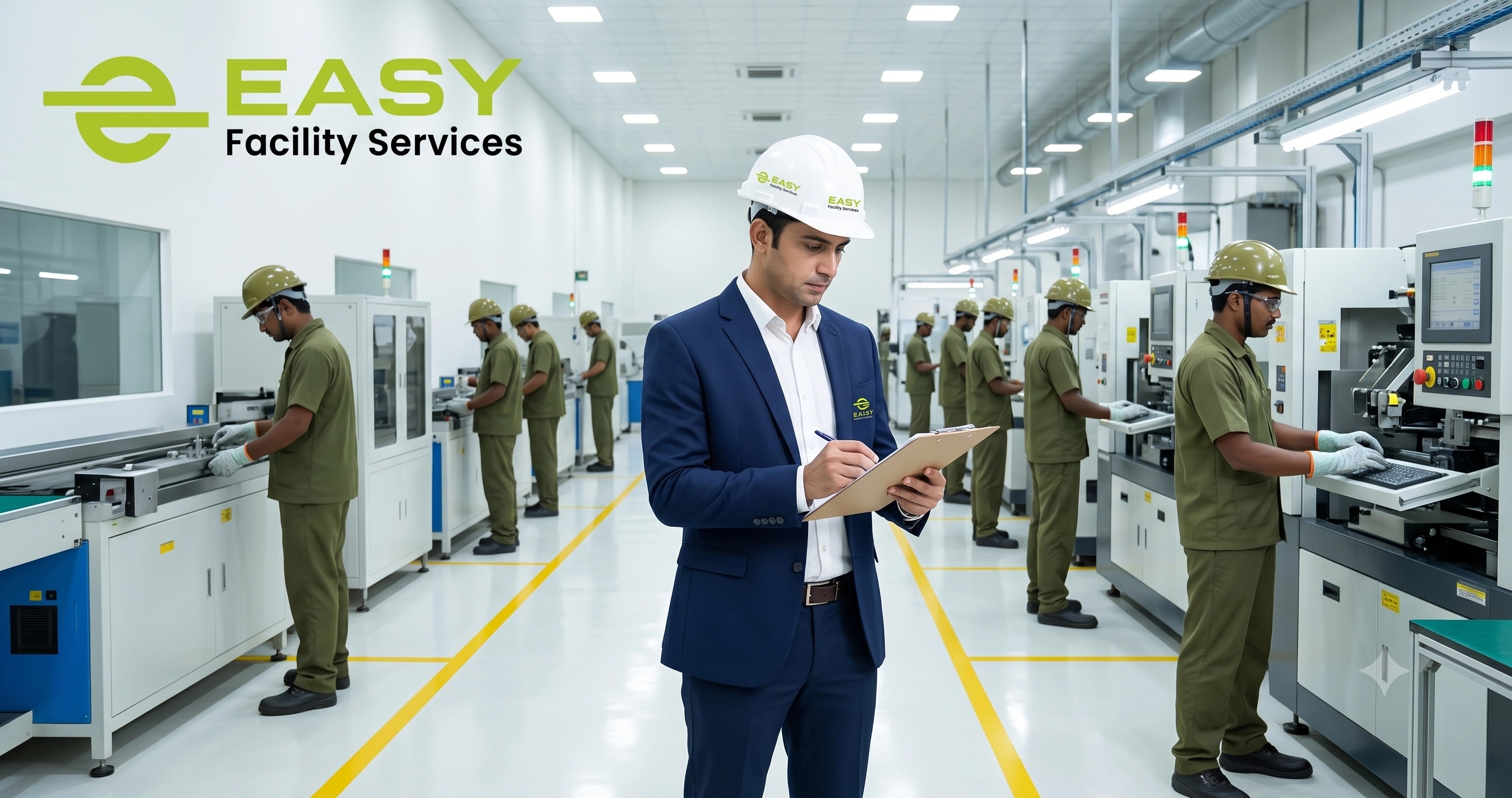
Professional facility management is critical for Chennai manufacturing units in 2026. This complete guide covers housekeeping, security, MEP, manpower, waste management and how to choose the right FM company for your manufacturing facility.
Chennai is one of India's most important manufacturing destinations.
The city's industrial corridors — Ambattur Industrial Estate, Guindy Industrial Estate, Sriperumbudur, Oragadam, Padi, Perungudi, and Thiruvallur — house thousands of manufacturing units spanning automobile components, electronics, pharmaceuticals, food processing, textiles, engineering goods, and fast-moving consumer goods. Chennai's manufacturing sector employs hundreds of thousands of workers and contributes significantly to Tamil Nadu's industrial output and India's export economy.
In this demanding industrial environment, facility management manufacturing Chennai is not an afterthought. It is a critical operational function that directly affects worker safety, production continuity, regulatory compliance, and the ability of manufacturing facilities to attract and retain both skilled workers and premium clients.
A manufacturing unit with professional facility management has clean, safe, and well-maintained production and welfare areas. Its security systems protect valuable equipment, raw materials, and finished goods. Its MEP systems are maintained to prevent production-disrupting failures. Its waste management meets TNPCB compliance requirements. Its manpower deployment is compliant and reliably staffed.
A manufacturing unit without professional facility management has the opposite — and pays for it in compliance penalties, production disruptions, worker dissatisfaction, and client audit failures.
In 2026, professional facility management for Chennai manufacturing units is not optional. This is the complete guide.
Facility Management Manufacturing Chennai: What Makes It Unique
Manufacturing facility management has specific characteristics that distinguish it significantly from commercial or residential FM — and that require specialist experience and capability from the facility management provider.
Safety is the primary priority: Manufacturing environments contain hazards — machinery, chemicals, electrical systems, forklifts, heavy loads, and hot processes — that create genuine risks to worker safety. Facility management in a manufacturing unit must be conducted with constant awareness of these hazards. Housekeeping teams must follow safety protocols. Maintenance teams must follow permit-to-work systems. Security teams must enforce safety regulations at entry and exit points. Safety is not one consideration among many in manufacturing FM — it is the overriding priority.
Production continuity dependency: In a manufacturing unit, the facility serves the production process. MEP system failures — power outages, compressed air failures, water supply interruptions — directly stop production. The cost of production downtime in a manufacturing facility is significant — often far exceeding the annual cost of the preventive maintenance programme that could have prevented the failure. Manufacturing facility management must prioritise system reliability above all other considerations.
Regulatory complexity: Chennai manufacturing units operate under a complex regulatory framework — Factory Act inspections, TNPCB environmental compliance, Tamil Nadu Labour Department oversight, fire safety certification, and OHSAS/ISO quality system requirements. Professional facility management integrates compliance management into its service — tracking certification requirements, maintaining documentation, and supporting regulatory inspections.
Large, diverse workforce: Manufacturing units typically employ large numbers of workers — direct employees, contract workers, technicians, and management staff — with different welfare needs, different access requirements, and different facility usage patterns. Facility management must serve this diverse workforce effectively.
Shift-based operations: Most Chennai manufacturing units operate on two or three shifts — some on a 24/7 basis. Facility management must provide consistent quality across all shifts, without the quality degradation that is common when supervision is reduced during night shifts.
Client and audit requirements: Manufacturing clients in premium sectors — automobile OEMs, pharmaceutical companies, electronics manufacturers — conduct regular facility audits of their suppliers. A manufacturing unit's facility standards directly affect its ability to retain premium clients and pass supplier audits.
Housekeeping Services for Chennai Manufacturing Units
Manufacturing facility housekeeping is significantly more demanding than commercial housekeeping — covering a wider range of surfaces, materials, and hazardous environments, with strict safety compliance requirements throughout.
Production floor housekeeping: Production floor cleanliness is a safety and quality requirement in manufacturing — not just an aesthetic one. Accumulated oil, grease, metal swarf, packaging waste, and general debris on production floors create slip hazards, fire risks, and contamination risks for the product. Professional production floor housekeeping teams follow specific safety protocols — using appropriate absorbent materials for oil spills, following machine isolation procedures before cleaning near equipment, and wearing appropriate PPE throughout.
Welfare area housekeeping: Worker welfare areas — canteens, restrooms, changing rooms, locker areas, and rest rooms — must be maintained to a consistently high standard. Manufacturing workers spend significant parts of their working day in these areas. The quality of welfare facilities directly affects worker morale, retention, and the perception of the organisation as an employer.
Office and administrative area housekeeping: Manufacturing units typically have administrative offices, quality control labs, conference rooms, and visitor reception areas that require commercial-standard housekeeping — distinct from the production floor environment.
Waste handling support: Manufacturing units generate multiple waste streams — general waste, recyclable materials, chemical waste, oily rags, metal scrap, and packaging waste. Housekeeping teams support waste segregation and collection at source — ensuring that waste is correctly handled and does not accumulate in production or welfare areas.
Deep cleaning: Manufacturing environments require periodic deep cleaning — of production equipment surrounds, welfare areas, drainage systems, and storage areas — at frequencies determined by the intensity of production activity and the nature of the manufacturing process.
Security Services for Chennai Manufacturing Units
Manufacturing facility security is a high-stakes function — protecting significant capital investments in equipment and machinery, valuable raw materials and finished goods inventories, and the intellectual property embedded in manufacturing processes.
Perimeter security: Manufacturing unit perimeters — boundary walls, fencing, service entrances, and emergency exits — require continuous security coverage, particularly during night hours when the risk of theft and vandalism is highest. Perimeter patrol guards conduct regular inspections of all boundary points, checking for security breaches, identifying vulnerabilities, and maintaining a deterrent presence.
Gate and access control: Manufacturing facility gates manage a constant flow of workers, contractors, vehicles, raw material deliveries, and finished goods dispatches. Professional security guards at manufacturing gates manage this flow systematically — verifying worker identity and access authorisation, checking contractor credentials and work permits, managing vehicle entry and exit logs, and overseeing material movement documentation.
Material movement control: Theft of raw materials, finished goods, and equipment from manufacturing units is a significant and preventable problem. Professional security management of material movement — verifying gate passes for all outgoing materials, conducting vehicle inspections, maintaining accurate dispatch logs — provides the accountability that prevents and detects unauthorised material movement.
Night security: Manufacturing units with high-value equipment and inventory are attractive targets for organised theft during night hours. Comprehensive night security — with alert guards at all entry points and regular perimeter patrol — is essential for any Chennai manufacturing unit that takes asset protection seriously.
Fire safety support: Manufacturing environments contain significant fire risks — flammable materials, electrical systems, hot processes, and chemical storage. Security guards at manufacturing facilities are trained in fire safety — operating fire alarm systems, conducting evacuation procedures, using fire extinguishers, and coordinating with fire services in the event of an emergency.
Contractor management: Manufacturing units have constant contractor traffic — civil contractors, equipment service teams, utility maintenance contractors, and IT service providers. Professional security management of contractor access — verifying authorisation, issuing visitor passes, escorting contractors to relevant areas, and maintaining contractor entry and exit records — prevents unauthorised access to sensitive production and storage areas.
MEP and Technical Maintenance for Chennai Manufacturing Units
Manufacturing unit MEP systems are production-critical infrastructure. System failures directly stop production — making preventive maintenance not just a facility management function but a production continuity strategy.
Power management: Manufacturing units are significant electricity consumers — with production machinery, HVAC systems, compressed air systems, lighting, and utility equipment all drawing substantial power. Electrical maintenance — covering main distribution boards, motor control centres, power factor correction, transformers, and DG sets — must prevent failures that stop production and protect sensitive equipment from power quality issues.
Compressed air systems: Many Chennai manufacturing units depend on compressed air for production processes — pneumatic machinery, assembly tools, painting and coating systems, and material handling. Compressed air system maintenance — compressor servicing, air dryer maintenance, pipe system inspection, and pressure monitoring — is often one of the most production-critical maintenance functions in the facility.
Water and cooling systems: Manufacturing processes often require process water supply, cooling water systems, and chilled water for temperature-sensitive operations. Water system maintenance — pump servicing, water quality monitoring, cooling tower maintenance, and process water treatment — is essential for production continuity.
HVAC and ventilation: Worker welfare, product quality, and safety in manufacturing environments depend on adequate ventilation and temperature control. Chennai's extreme summer heat makes HVAC reliability particularly critical for both worker comfort and production quality in temperature-sensitive manufacturing processes.
Plumbing and drainage: Manufacturing units generate significant wastewater — from production processes, welfare facilities, and utility systems. Drainage system maintenance — clearing blockages, maintaining sumps and treatment systems, and ensuring TNPCB-compliant effluent quality — is a regulatory as well as an operational requirement.
Preventive maintenance scheduling: Professional manufacturing facility MEP maintenance is built on a planned preventive maintenance schedule — with monthly, quarterly, and annual maintenance activities planned and documented. This schedule-based approach prevents the unplanned failures that cause production disruption.
Manpower Services for Chennai Manufacturing Units
Manufacturing units are significant employers of contract and temporary workforce — for production support, material handling, packaging, quality inspection, housekeeping, security, and general operations. Professional manpower services provide manufacturing units with reliable, verified, compliant contract workers across all these categories.
Professional manpower services for manufacturing units include full statutory compliance — PF, ESI, Tamil Nadu minimum wages — with monthly documentation that protects the manufacturing unit from principal employer liability under the Contract Labour Act.
Manpower services also provide the flexibility that manufacturing demand variability requires — scaling workforce up during peak production periods and down during slower periods, without the overhead and legal complexity of directly managing fluctuating headcount.
Waste Management and Environmental Compliance for Chennai Manufacturing Units
Chennai manufacturing units are subject to comprehensive environmental regulations enforced by the Tamil Nadu Pollution Control Board (TNPCB) — covering air emissions, effluent discharge, solid waste management, and hazardous waste handling.
General solid waste: Manufacturing units generating more than 100kg of waste per day are classified as bulk waste generators under the Solid Waste Management Rules 2016 — with mandatory waste segregation and documented disposal requirements. Professional waste management services implement compliant waste management programmes and provide the documentation required for regulatory compliance.
Hazardous waste: Manufacturing units generating hazardous waste — chemicals, solvents, oils, metal sludges, and other regulated materials — must manage this waste through TNPCB-authorised hazardous waste treatment and disposal facilities, with complete documentation of generation and disposal quantities.
Effluent treatment: Manufacturing units with process wastewater must maintain effluent treatment plants (ETPs) and meet TNPCB discharge standards. ETP maintenance and regular effluent testing are regulatory requirements.
Environmental compliance documentation: TNPCB inspections of manufacturing units cover waste management practices, effluent quality, and environmental compliance documentation. Professional facility management integrates environmental compliance management — maintaining required records and supporting regulatory inspections.
Pest Control for Chennai Manufacturing Units
Manufacturing units — particularly those involved in food processing, pharmaceuticals, and any production where contamination is a quality or safety concern — require professional pest management as part of their quality assurance system.
Chennai's warm climate creates persistent pest pressure in manufacturing environments — rodents attracted to food materials and warmth, cockroaches in welfare and food preparation areas, ants in storage areas, and flies in waste and food service areas.
Professional pest control services for manufacturing units use an Integrated Pest Management approach — combining scheduled treatments with proactive proofing and monitoring. For food manufacturing and pharmaceutical facilities, pest control documentation is a quality system requirement — audited by clients, certification bodies, and regulatory inspectors.
Housekeeping and Welfare — The Worker Retention Connection
In Chennai's competitive manufacturing labour market, worker welfare is a genuine business priority — not just a compliance requirement.
Manufacturing units that invest in clean, well-maintained welfare facilities — good canteens, clean restrooms, comfortable rest areas — find it easier to recruit and retain workers. Those with poor welfare facilities face higher attrition, higher recruitment costs, and the productivity loss that comes with constant workforce turnover.
Professional facility management that consistently maintains high welfare facility standards is a direct investment in worker retention — and in the stable, experienced workforce that manufacturing quality depends on.
How to Choose the Right Facility Management Company for Your Chennai Manufacturing Unit
Manufacturing experience: Has the company provided facility management services to manufacturing units before? Manufacturing FM requires specific safety awareness, process knowledge, and operational understanding that general commercial FM companies may not have. Ask for manufacturing client references specifically.
Safety compliance: Does the company train their staff in manufacturing safety protocols — PPE requirements, permit-to-work systems, chemical handling, and emergency procedures? Safety compliance in a manufacturing environment is non-negotiable.
Statutory compliance: Full PF, ESI, Tamil Nadu minimum wages, and Factory Act compliance for deployed contract workers — with monthly documentation — is essential. The Contract Labour Act principal employer provisions apply with full force in manufacturing environments.
Shift coverage: Can they provide consistent quality across all production shifts — including nights and weekends? Ask specifically about supervision arrangements for night shifts.
Environmental compliance support: For manufacturing units with TNPCB obligations, can the facility management company support environmental compliance documentation and inspection readiness?
Integrated capability: Can they provide housekeeping, security, MEP maintenance, manpower, pest control, and waste management under one contract? Single-vendor accountability simplifies management and eliminates coordination gaps.
References: Ask for references from manufacturing unit clients in Chennai — specifically in industrial areas like Ambattur, Sriperumbudur, and Guindy. Visit facilities they currently manage.
How Easy Facility Services Manages Manufacturing Facility Management in Chennai
At Easy Facility Services Private Limited, we have extensive experience providing professional facility management services to manufacturing units across Chennai's industrial corridors — Ambattur Industrial Estate, Guindy Industrial Estate, Sriperumbudur, Oragadam, Padi, and Thiruvallur.
Our manufacturing FM offering covers the complete service spectrum — housekeeping services, security services, MEP services, manpower services, pest control, waste management, building maintenance, electrical services, plumbing services, and deep cleaning — all under one contract, one point of contact, and complete accountability.
Our staff deployed in manufacturing environments receive safety induction training appropriate to the industrial setting — PPE requirements, hazard awareness, emergency procedures, and manufacturing-specific safety protocols. All staff are background verified, uniformed, and supervised.
We maintain full statutory compliance for all deployed staff — PF, ESI, Tamil Nadu minimum wages — and provide monthly compliance documentation that supports our manufacturing clients' principal employer compliance obligations and client audit requirements.
If you manage a manufacturing unit in Chennai and would like to discuss how professional integrated facility management can improve your safety standards, production continuity, compliance position, and worker welfare, our team would be happy to conduct a free facility assessment.
Get a Free Manufacturing FM Assessment | Call us: +91 73059 12983
Ravikumar is the CTCO of Easy Facility Services Private Limited, one of Chennai's leading industrial and manufacturing facility management companies. Easy Facility Services provides professional facility management services, housekeeping, security, MEP services, manpower services, pest control, waste management, and integrated facility management manufacturing Chennai support for manufacturing units across Chennai and Tamil Nadu since 2015.
Ravikumar
CTCO, Easy Facility Services Private Limited
With over 10 years of experience in facility management across Chennai and Tamil Nadu, leading Easy Facility Services Private Limited to serve 500+ businesses.