
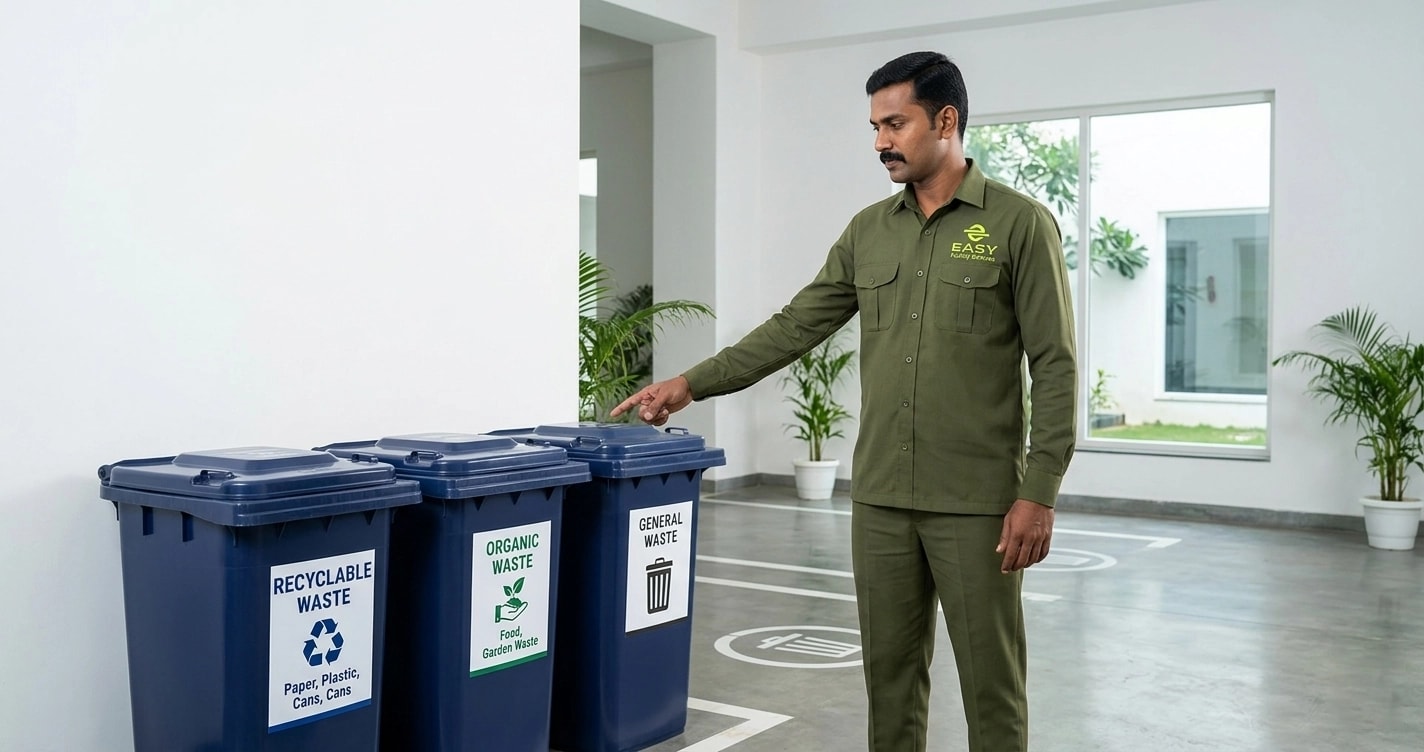
Waste management is a legal obligation for Chennai businesses in 2026 — not just a facility function. This complete guide covers TNPCB compliance, waste segregation, and how professional waste management services protect your business.
Waste management is one of the most underestimated facility functions in Chennai businesses.
Most business owners think of waste management as simple — put it in a bin, someone collects it, problem solved. But in 2026, professional waste management is significantly more complex than that. It involves regulatory compliance, waste segregation protocols, authorised disposal channels, environmental obligations, and documentation requirements that affect businesses of every size across Chennai.
Get it wrong, and the consequences range from TNPCB notices and fines to facility hygiene failures that affect your employees, your clients, and your reputation.
Get it right, and waste management becomes a seamless, compliant, and cost-effective facility function that you never have to think about.
This is the complete guide to professional waste management for Chennai businesses in 2026 — covering the legal framework, the practical requirements, and how to implement an effective waste management programme for your facility.
The Legal Framework — What Chennai Businesses Must Know
Waste management in India is governed by a comprehensive regulatory framework that most Chennai business owners are not fully aware of. Understanding your obligations is the essential starting point.
Solid Waste Management Rules 2016: The Ministry of Environment, Forest and Climate Change's Solid Waste Management Rules 2016 place clear obligations on bulk waste generators — defined as commercial establishments generating more than 100kg of waste per day. Under these rules, bulk waste generators must:
- Segregate waste at source into biodegradable, non-biodegradable and domestic hazardous categories
- Store segregated waste in separate containers
- Hand over segregated waste to authorised waste collectors
- Not mix different categories of waste
Tamil Nadu Pollution Control Board (TNPCB): The TNPCB enforces environmental regulations across Tamil Nadu including waste management compliance. Healthcare facilities, industries, and large commercial establishments are subject to TNPCB authorisations and inspections. Non-compliance carries fines, closure orders, and in serious cases, criminal liability.
Biomedical Waste Management Rules 2016: Healthcare facilities — hospitals, clinics, diagnostic centres, dental practices — are subject to specific biomedical waste management rules that require proper segregation, colour-coded container systems, and disposal only through TNPCB-authorised biomedical waste treatment facilities.
E-Waste Management Rules: Businesses generating electronic waste — old computers, phones, printers, batteries — are required to channel e-waste to authorised recyclers. Simply dumping e-waste with general waste is a regulatory violation.
Plastic Waste Management Rules: Single-use plastics are banned under Tamil Nadu regulations. Businesses are required to manage plastic waste appropriately and ensure compliance with plastic waste rules.
The regulatory landscape is complex — and it is tightening. In 2026, Chennai businesses that treat waste management casually are taking a significant compliance risk.
Waste Segregation — The Foundation of Effective Waste Management
Waste segregation at source is the cornerstone of an effective waste management programme. It is also a legal requirement for bulk waste generators in Chennai.
Proper waste segregation means separating waste into distinct categories at the point of generation — before it is collected and disposed of. The key categories for most Chennai commercial facilities are:
Biodegradable / Organic Waste (Green bin): Food waste, vegetable peels, paper, cardboard, garden waste, and other organic materials that can be composted or processed biologically. For Chennai restaurants, hospitals and corporate cafeterias, organic waste is typically the highest-volume category.
Non-Biodegradable / Dry Recyclable Waste (Blue bin): Plastic bottles and packaging, glass, metal cans, aluminium, hard plastics, and other materials that can be recycled. This waste must be clean and dry before segregation.
General / Residual Waste (Black/Grey bin): Waste that does not fit into other categories — contaminated materials, broken items, and non-recyclable materials that go to landfill.
Hazardous Waste (Red bin): Batteries, paint, solvents, cleaning chemicals, fluorescent tubes, and other materials that require specialist disposal. For healthcare facilities, this category includes all biomedical waste categories.
E-Waste (Separate collection): Electronic waste requires separate collection and must be channelled to TNPCB-authorised e-waste recyclers.
Implementing a waste segregation system in your Chennai facility requires clearly labelled, colour-coded bins at appropriate locations throughout the facility, staff training on correct segregation, regular auditing of segregation compliance, and a collection system that maintains separation through to disposal.
Waste Management for Different Chennai Business Types
Different types of Chennai businesses generate different waste streams — and require different waste management approaches.
Corporate Offices and IT Parks: The primary waste streams from Chennai offices are paper and cardboard, food waste from canteens and pantries, plastic packaging, electronic waste, and general refuse. A well-managed office waste programme can divert 60–70% of total waste from landfill through recycling and composting. Regular paper shredding for confidential documents is also an important waste management component for corporate offices.
Restaurants and Commercial Kitchens: Food waste is the dominant waste stream for Chennai restaurants — and one of the most important to manage correctly. Organic waste composting or biogas conversion programmes can significantly reduce the environmental and cost impact of food waste. Kitchen waste also includes used cooking oil, which must be disposed of through authorised channels — not poured down drains. Grease trap waste requires periodic collection by authorised contractors.
Hospitals and Healthcare Facilities: Healthcare waste management is the most regulated and complex category. Chennai hospitals must maintain strict biomedical waste segregation across four categories (yellow, red, white, blue bags and containers), maintain records of all biomedical waste generated and disposed of, use only TNPCB-authorised biomedical waste treatment facilities, and ensure all staff are trained in biomedical waste handling. Non-compliance carries severe penalties and can affect hospital accreditation.
Manufacturing and Industrial Facilities: Manufacturing facilities in Chennai's industrial areas — Ambattur, Guindy, Sriperumbudur, Padi — generate industrial waste streams that may include hazardous materials, chemical waste, metal scrap, and process residues. These require TNPCB authorisation, proper storage, and disposal through authorised industrial waste contractors. Industrial waste management is subject to the most stringent regulatory requirements of any business category.
Hotels and Hospitality: Hotels generate significant food waste, linen waste, packaging waste, and guest-generated general refuse. Professional waste management for hotels includes kitchen waste programmes, linen recycling partnerships, and comprehensive recyclables collection systems that support sustainability commitments increasingly demanded by guests and corporate clients.
The Hidden Costs of Poor Waste Management in Chennai
Most Chennai business owners who underinvest in waste management believe they are saving money. The reality is usually the opposite.
Regulatory fines: TNPCB notices and municipal corporation fines for waste management violations range from thousands to lakhs of rupees — far exceeding the annual cost of professional waste management services.
Pest infestations: Poorly managed waste — particularly food waste — attracts pests. A pest infestation in a Chennai restaurant or office costs significantly more to remediate than a proper waste management programme costs to implement. It also carries reputational damage that is difficult to quantify.
Increased collection costs: When waste is not properly segregated, recyclable materials that could have been collected free of charge or at low cost by recyclers instead go to general waste — increasing disposal costs. Proper segregation reduces total waste disposal costs.
Employee health and morale: Inadequate waste management creates hygiene issues, odour problems, and an unpleasant working environment that affects employee health, morale, and productivity.
Reputational damage: For customer-facing businesses in Chennai — restaurants, hotels, healthcare facilities — waste management failures that become visible to customers cause immediate and lasting reputational damage.
Building an Effective Waste Management Programme for Your Chennai Facility
Implementing professional waste management at your Chennai facility involves five steps:
Step 1 — Waste audit: Understand what waste your facility generates — volumes, types, and sources. A professional waste management company will conduct this assessment for you.
Step 2 — Segregation system design: Design and implement a segregation system appropriate for your facility — bin locations, container specifications, signage, and collection points.
Step 3 — Staff training: Every staff member who generates or handles waste must be trained on correct segregation. This is not a one-time training — it requires periodic reinforcement.
Step 4 — Collection and disposal contracts: Establish contracts with authorised waste collectors for each waste stream — general waste, recyclables, organic waste, hazardous waste as applicable. All disposal contractors must be TNPCB authorised.
Step 5 — Monitoring and documentation: Maintain records of waste generated and disposed of. For regulated waste streams, this documentation is a legal requirement. Regular auditing ensures the system continues to operate correctly.
How Easy Facility Services Manages Waste for Chennai Businesses
At Easy Facility Services Private Limited, our waste management services provide Chennai businesses with a complete, compliant waste management programme — from waste audit and system design through to ongoing collection, documentation, and compliance management.
Our waste management teams are trained in current TNPCB regulations and Tamil Nadu waste management rules. We work with authorised disposal contractors for all waste streams and provide clients with documentation that supports their compliance obligations.
We integrate waste management seamlessly with our broader facility management soft services — combining waste management with housekeeping services, deep cleaning, pest control, and security services for a comprehensive facility management solution.
Our clients across Chennai — corporate offices, hospitals, hotels, restaurants, and manufacturing facilities — trust Easy Facility Services to keep their facilities clean, compliant, and professionally managed.
If you would like to understand how professional waste management can benefit your Chennai business — and ensure your regulatory compliance — our team would be happy to conduct a free waste management assessment.
Get a Free Waste Management Assessment | Call us: +91 73059 12983
Ravikumar is the CTCO of Easy Facility Services Private Limited, one of Chennai's leading facility management companies. Easy Facility Services provides professional waste management services, housekeeping services, deep cleaning, pest control, security services, MEP maintenance, and integrated facility management across Chennai and Tamil Nadu since 2015.
Ravikumar
CTCO, Easy Facility Services Private Limited
With over 10 years of experience in facility management across Chennai and Tamil Nadu, leading Easy Facility Services Private Limited to serve 500+ businesses.