
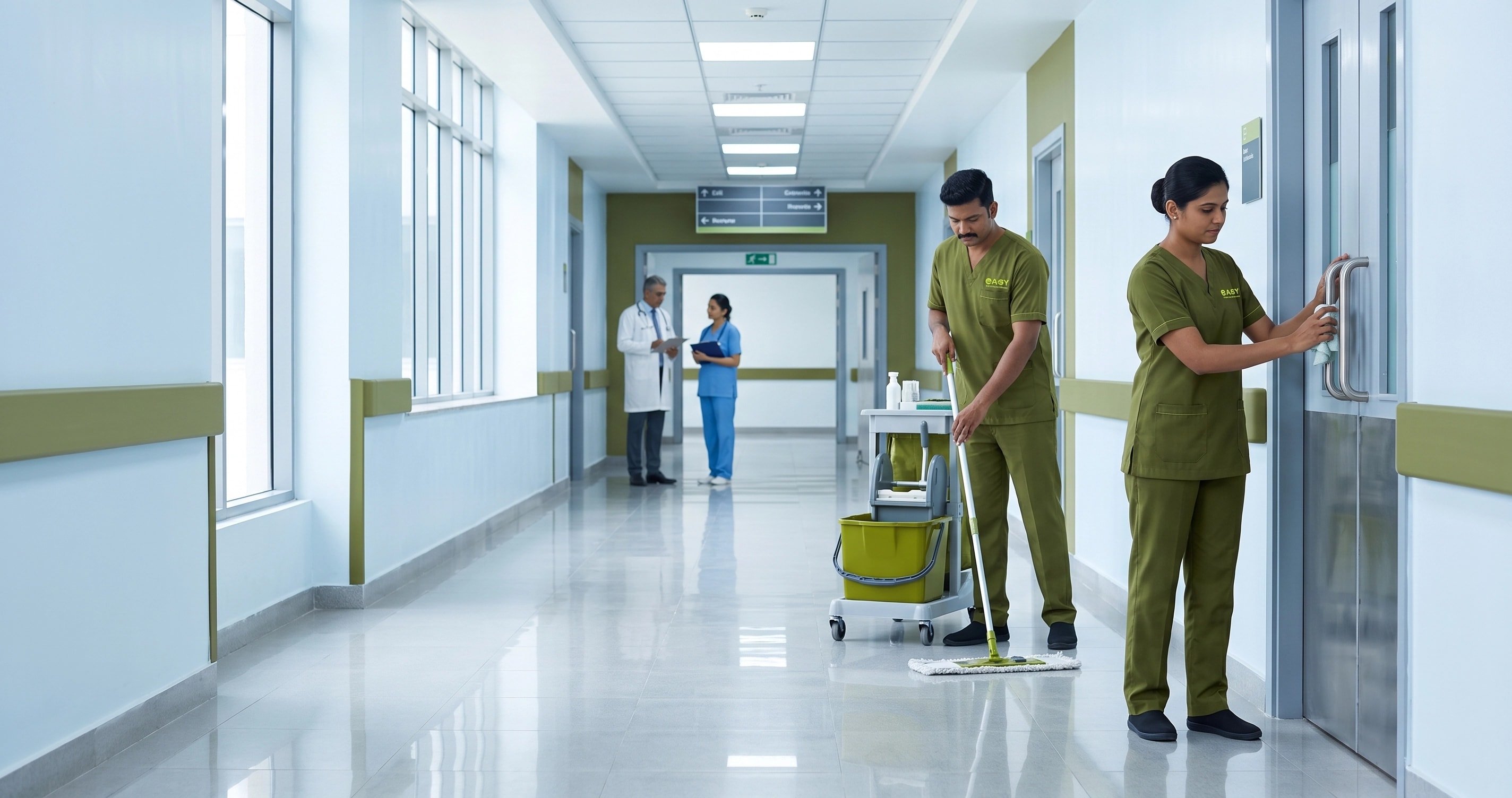
Hospital facility management in Chennai requires the highest standards of hygiene, compliance, and service delivery. This complete 2026 guide covers everything hospital administrators need to know about professional facility management.
Chennai is one of India's most important healthcare destinations.
Every year, millions of patients travel to Chennai from across Tamil Nadu, Andhra Pradesh, Kerala, Karnataka, and from countries across Asia and Africa — seeking diagnosis, treatment, and speciality medical care that is not available closer to home. Chennai's hospitals — from the large multi-speciality institutions of Anna Nagar, Adyar, and Kilpauk to the growing healthcare corridor of OMR and the established medical clusters of Nungambakkam and T. Nagar — serve this enormous and diverse patient population with a standard of clinical care that has made the city a global medical destination.
Behind every successful hospital in Chennai, there is a facility management function that most patients and visitors never consciously notice — but that affects every aspect of their experience and safety.
A patient who is transported safely from the ward to the operation theatre. An ICU that is maintained to infection control standards that protect critically ill patients. A hospital lobby that is clean and professionally presented. A security team that manages visitor access with sensitivity and professionalism. A building that is properly maintained — with reliable power, working plumbing, and fire systems that are certified and functional.
These are not peripheral concerns. They are core to the delivery of safe, high-quality healthcare. And in Chennai's competitive and demanding healthcare environment, professional hospital facility management is not optional. It is a clinical imperative.
This is the complete guide to professional facility management for Chennai hospitals in 2026.
Why Hospital Facility Management Is Different From All Other Facility Management
Hospital facility management is the most complex, most regulated, and most consequential application of facility management services. Understanding why helps hospital administrators appreciate the importance of choosing specialist providers — not general commercial facility management companies.
Patient safety is directly at stake: In a commercial office, a housekeeping failure means a dirty floor. In a hospital, a housekeeping failure means a potential source of hospital-acquired infection that could harm or kill a patient. The consequences of facility management failures in hospitals are measured in patient outcomes — not just in appearance or comfort.
Regulatory compliance is non-negotiable: Chennai hospitals seeking or maintaining NABH (National Accreditation Board for Hospitals) accreditation must meet comprehensive facility management standards — documented housekeeping protocols, infection control compliance, biomedical waste management, fire safety certification, and equipment maintenance records. Non-compliance affects accreditation status, which affects the hospital's ability to attract patients, insurance empanelments, and staff.
24/7 operations with no margin for failure: Hospitals never close. Operations in critical care, emergency medicine, and maternity services continue around the clock, every day of the year. Facility management services must maintain quality standards across all shifts — including nights, weekends, and public holidays — without any degradation of standards or gaps in coverage.
Vulnerable population: Hospital patients are, by definition, unwell — many are immunocompromised, sedated, in pain, or otherwise unable to advocate for themselves. The standard of care they receive from facility management staff — particularly wardboys, housekeeping personnel, and security guards — directly affects their comfort, dignity, and safety.
Infection control complexity: The risk of hospital-acquired infections (HAIs) is a constant and serious concern in any hospital. HAIs are associated with significant patient morbidity, mortality, and healthcare costs. Effective infection control depends substantially on facility management — correct housekeeping protocols, appropriate disinfection, biomedical waste management, and ventilation maintenance.
Multi-disciplinary coordination: Hospital facility management requires constant coordination with clinical teams — scheduling maintenance activities around patient care, managing housekeeping without disrupting clinical operations, and responding to facility issues without affecting patient safety. This coordination requires experienced professionals who understand the hospital environment.
Housekeeping Services for Chennai Hospitals — Infection Control at the Core
Hospital housekeeping is not the same as commercial housekeeping. It requires specific training, specific protocols, specific chemicals, and a specific understanding of the infection control requirements of a healthcare environment.
Zone-based cleaning: Chennai hospitals are divided into zones based on infection risk — from general administrative areas and public spaces (low risk) through general wards and outpatient departments (medium risk) to critical care units, isolation rooms, operation theatres, and procedure rooms (high risk). Each zone requires different cleaning frequencies, different disinfectants, different personal protective equipment, and different staff training.
Professional hospital housekeeping staff are trained in zone-based cleaning protocols — understanding which zone they are working in, what products and methods are appropriate, and how to transition between zones without creating cross-contamination risks.
Terminal cleaning: When a patient is discharged or transferred, their bed area requires terminal cleaning — a thorough, documented cleaning and disinfection process that prepares the space for the next patient. Terminal cleaning must follow a documented protocol, use appropriate hospital-grade disinfectants, and be completed to a documented standard. NABH requires terminal cleaning records as part of its accreditation standards.
Operation theatre housekeeping: OT cleaning is the most demanding and most critical hospital housekeeping function. Pre-operative cleaning, between-case cleaning, and end-of-day terminal cleaning all require strict protocols — specific disinfectants, specific equipment (that is not shared with other areas of the hospital), specific personal protective equipment, and documented compliance. OT housekeeping staff require specific training and must understand the critical importance of their role in infection prevention.
Infection control products and equipment: Professional hospital housekeeping uses colour-coded equipment — different coloured mops, buckets, and cloths for different zones — to prevent cross-contamination. Hospital-grade disinfectants appropriate to each zone are used at correct dilutions and contact times. Personal protective equipment — gloves, aprons, masks — is worn appropriately and changed between zones.
Documentation: NABH accreditation requires housekeeping records — daily cleaning logs, terminal cleaning records, product usage records, and quality inspection documentation. Professional hospital housekeeping services provide this documentation as a standard part of their service.
Biomedical waste support: While biomedical waste management is a clinical function, housekeeping staff play an important role in maintaining the cleanliness of waste collection points and ensuring that waste is not allowed to accumulate in clinical areas. Professional hospital housekeeping teams are trained in the different biomedical waste categories and the correct handling of waste collection areas.
Security Services for Chennai Hospitals — Sensitivity and Professionalism
Hospital security in Chennai presents unique challenges that require specifically trained security personnel — guards who combine effective access control with the sensitivity and compassion appropriate to a healthcare environment.
Patient and visitor management: Hospitals manage a constant flow of patients, family members, visitors, and medical staff — in an environment where emotions run high, where vulnerable people are present at their most difficult moments, and where the balance between security and compassionate access must be carefully managed. Security guards at hospital entrances and ward access points must be trained in this specific balance.
Restricted area protection: Hospitals have multiple restricted areas — ICUs with visiting hour controls, pharmacies, blood banks, operation theatres, medical record rooms, and paediatric wards. Professional security staff understand and enforce restricted area protocols consistently and courteously — protecting patients and clinical operations while treating family members with respect.
Lady guards for female patient areas: Maternity wards, gynaecology departments, and other female-only clinical areas require lady guards — female security personnel who provide appropriate security coverage while maintaining the dignity and privacy of female patients.
Night security: A hospital at 3am is as active as any time of day — with emergency admissions, clinical procedures, and patients who need assistance. Night security in Chennai hospitals must maintain the same professional standard as day coverage — with alert, trained guards at all posts and supervisors conducting regular rounds.
Emergency response: Hospital security teams must be trained in emergency response protocols — managing fire evacuations while considering patients who cannot self-evacuate, handling medical emergencies in public areas, managing distressed or aggressive family members, and coordinating with police and emergency services when required.
CCTV monitoring: Hospital CCTV systems cover critical areas — pharmacies, blood banks, cash counters, car parks, and entry points. Professional security management includes trained CCTV operators who monitor feeds, respond to alerts, and maintain surveillance records.
Wardboy Services — The Backbone of Patient Movement
Wardboy services are the patient support function that keeps a hospital's patient flow moving safely and efficiently. Professional wardboys are trained in safe patient handling, infection control, and the specific sensitivities of patient interaction.
In a busy Chennai hospital, wardboys are responsible for transporting patients between departments — from ward to OT, from ICU to general ward, from ward to radiology, from emergency to ICU. They assist patients who cannot move independently, handle patients with active IV lines and oxygen support, and transport critically ill patients with monitoring equipment.
Professional wardboy services ensure that every patient movement is handled safely, with dignity, and by staff who understand both the physical technique and the human dimension of patient transport. Read more about professional wardboy services for Chennai hospitals.
Lab Technician Services — Quality at the Diagnostic Foundation
Lab technician services provide Chennai hospitals and diagnostic centres with qualified, verified clinical laboratory staff — covering haematology, biochemistry, microbiology, blood bank, histopathology, and phlebotomy functions.
Professional lab technician services ensure that every technician deployed holds a verified DMLT or BMLT qualification, has been assessed for relevant technical competency, and has received facility-specific induction covering the laboratory's SOPs and quality management system.
For NABH-accredited hospitals, lab technician qualification records and competency assessments are required documentation. Professional lab technician services provide this documentation as a standard part of their service.
MEP and Technical Maintenance for Chennai Hospitals
Hospital building systems must maintain the highest reliability standards of any building type. System failures in a hospital have direct patient safety implications.
Critical power management: Hospitals must maintain uninterrupted power to critical care areas, operation theatres, emergency departments, and life support systems. Critical power systems — UPS, automatic transfer switches, DG sets, and dedicated critical circuits — require specialist maintenance and must be tested regularly to confirm their reliability. Power quality must be maintained to protect sensitive medical equipment.
HVAC and infection control: Hospital HVAC systems play a direct role in infection control — particularly in operation theatres, ICUs, and isolation rooms where positive or negative pressure relationships and high air change rates are required. HVAC maintenance for these critical areas must be performed by technicians who understand the infection control implications of their work.
Medical gas systems: Hospitals with piped medical gas systems — oxygen, nitrous oxide, compressed air, vacuum — require maintenance that is distinct from standard building services. Medical gas system maintenance requires specialist certification and must be performed without interruption to clinical supply.
Lift reliability: Patient transport depends on reliable lift operation. Lift downtime in a hospital affects patient safety — particularly for patients requiring urgent transport between floors. Regular lift servicing and rapid emergency response to lift faults are essential in a hospital environment.
Plumbing and water quality: Hospital water systems must meet stringent quality standards — hot water systems must maintain temperatures that prevent Legionella growth, water supplies to clinical areas must be tested for bacterial contamination, and wastewater from clinical areas must be managed appropriately. Hospital plumbing maintenance requires specific expertise and compliance awareness.
Fire safety systems: Hospital fire safety is particularly complex because of the presence of patients who cannot self-evacuate. Fire alarm systems, sprinkler systems, fire hydrants, emergency lighting, and evacuation equipment must all be maintained to certified standards. Fire safety documentation is a NABH requirement and a Tamil Nadu Fire and Rescue Services regulatory requirement.
Waste Management for Chennai Hospitals — Compliance and Safety
Hospital waste management is the most regulated and most complex waste management function — governed by the Biomedical Waste Management Rules 2016 and enforced by the Tamil Nadu Pollution Control Board (TNPCB).
Biomedical waste segregation: Hospitals must maintain strict biomedical waste segregation across four categories — yellow bag (infectious waste, body fluids, pathological waste), red bag (recyclable contaminated plastics), white/translucent container (sharps), and blue bag (glass). Each category must be collected and stored in appropriate containers and transferred to TNPCB-authorised biomedical waste treatment facilities.
General waste management: Hospitals generate significant volumes of general waste from administrative areas, public spaces, cafeterias, and non-clinical departments. Professional waste management for these areas includes waste segregation into dry recyclables and general waste, scheduled collection, and documented disposal.
Record keeping: TNPCB requires hospitals to maintain records of all biomedical waste generated and disposed of. Professional waste management services provide this documentation as part of their service.
Caretaker Services for Chennai Hospitals
Caretaker services in a hospital context provide dedicated support for the day-to-day operational management of specific hospital areas or support functions — managing utility systems, coordinating maintenance activities, handling resident/patient family requests in long-stay units, and serving as a professional operational point of contact for ward managers and clinical staff.
Choosing the Right Facility Management Partner for Your Chennai Hospital
Healthcare specialisation: Has the company provided facility management services to hospitals before? Healthcare facility management requires specific knowledge — infection control, NABH documentation requirements, biomedical waste protocols, medical gas awareness, and the operational sensitivity of a clinical environment. General commercial FM companies without healthcare experience are not appropriate for hospital environments.
NABH documentation support: Can the company provide the documentation required to support your NABH accreditation — housekeeping logs, terminal cleaning records, maintenance records, and staff training documentation? This is non-negotiable for accredited hospitals.
Infection control training: What specific infection control training do their housekeeping staff receive? Zone-based cleaning protocols, appropriate disinfectant selection and dilution, PPE use, and hand hygiene must all be part of the training programme.
24/7 capability: Can they provide consistent quality coverage across all shifts? Ask about supervision arrangements for night shifts and weekends.
Background verification: Every person deployed in a hospital — housekeeping, security, wardboy, lab technician — must be thoroughly background verified. This is non-negotiable in a patient care environment.
Statutory compliance: Full PF, ESI, and minimum wage compliance with monthly documentation is essential. Many hospital clients have compliance audit requirements from accreditation bodies and insurance empanelment requirements.
References: Ask for references from current hospital clients in Chennai. Visit a hospital they currently serve if possible.
How Easy Facility Services Manages Hospital Facility Management in Chennai
At Easy Facility Services Private Limited, we have extensive experience providing integrated facility management services to Chennai's healthcare sector — hospitals, nursing homes, diagnostic centres, and speciality clinics across the city.
Our hospital facility management offering covers the complete healthcare FM spectrum — housekeeping services with infection control training, security services with hospital sensitivity training, wardboy services, lab technician services, MEP services, plumbing services, electrical services, pest control, waste management, deep cleaning, building maintenance, and manpower services — all under one contract, one point of contact, and full accountability.
We provide NABH-ready documentation for all facility management functions — housekeeping logs, terminal cleaning records, maintenance records, and staff training records — as a standard part of our hospital service.
Every staff member we deploy in a healthcare environment is background verified, specifically trained for the healthcare setting, uniformed, and supervised by a dedicated healthcare facility supervisor. We maintain full statutory compliance for all deployed staff and provide monthly compliance documentation.
If you manage a hospital or healthcare facility in Chennai and would like to discuss how professional integrated facility management can support your clinical operations, accreditation requirements, and patient safety goals, our team would be happy to conduct a free facility assessment.
Get a Free Hospital Facility Management Assessment | Call us: +91 73059 12983
Ravikumar is the CTCO of Easy Facility Services Private Limited, one of Chennai's leading healthcare facility management companies. Easy Facility Services provides professional facility management services, housekeeping, security, wardboy services, lab technician services, MEP services, pest control, waste management, and integrated facility management for hospitals and healthcare facilities across Chennai and Tamil Nadu since 2015.
Ravikumar
CTCO, Easy Facility Services Private Limited
With over 10 years of experience in facility management across Chennai and Tamil Nadu, leading Easy Facility Services Private Limited to serve 500+ businesses.